What is flexor tenosynovitis?
It is the catching of the flexor tendon as it slides in the digital sheath.
On the palmar surface of the finger, the flexor tendon passes through successive pulleys that press it against the skeleton to optimize coiling.
Trigger finger is the occurrence of inflammation at the passage of the 1st pulley, causing tendon swelling and a mismatch between tendon volume and the available tunnel for passage. This results in pain at the pulley level, then catching during flexion-extension, responsible for triggering, then limitation of extreme finger movements with joint stiffening. Sometimes inflammation of the extensor can be found.
The precise cause of this disease is most often not identified. Many diseases can favor its occurrence, with the most common being: hypothyroidism, diabetes, hormonal changes including pregnancy, certain rheumatic diseases, previous surgery for carpal tunnel syndrome (even though this is not a complication of this operation per se)...
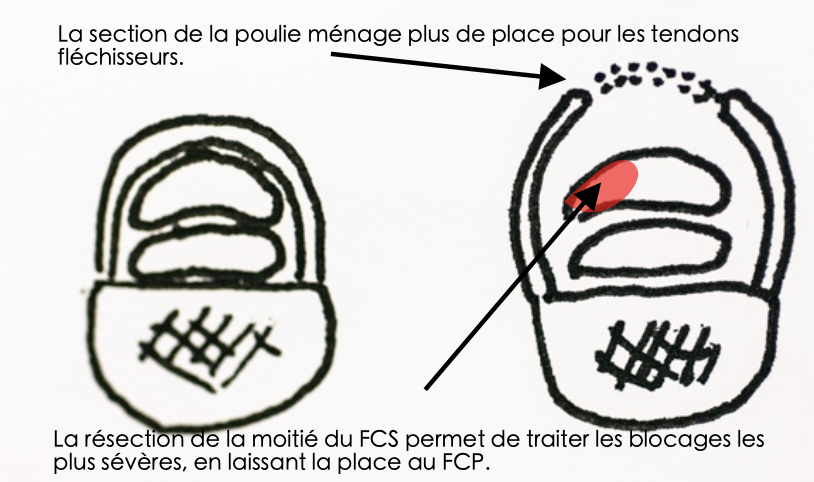
The procedure aims to remove synovitis and open the A1 pulley to facilitate tendon sliding. Sectioning the pulley provides more space for flexor tendons. Resection of half the FCS allows treatment of the most severe blockages
I have flexor tenosynovitis, what can be done?
Therapeutic abstention
If tendon catching is very mild and the situation is very minimally bothersome, therapeutic abstention can be proposed, as the situation sometimes improves with rest and stretching.
Corticosteroid infiltration
If tenosynovitis is recent and catching is mild, a corticosteroid infiltration can sometimes be performed. It reduces inflammation and therefore promotes tendon sliding. Unfortunately, its effectiveness is not always sufficient, and sometimes only temporary.
Surgical treatment
When blockages are recurrent, bothersome, present for a long time or responsible for joint stiffening, surgery is often preferable.
Similarly when several fingers are simultaneously involved, as surgery offers a more consistent result.
I'm going to have flexor tenosynovitis surgery... what will happen to me?
It is a short-duration procedure, under regional or local anesthesia, most often on an outpatient basis.
Surgical principle
Surgery aims to section the A1 pulley to leave more space for the tendon which will no longer "catch" on its path. The surgeon will also remove excess inflammatory synovial tissue.
Complementary procedure for old blockages
When blockage is old, the superficial flexor tendon (FCS) widens and also conflicts with the A2 pulley, which cannot be opened without consequence: the surgeon may then need to thin the tendon by removing a strip of this tendon, to facilitate sliding of the remaining tendon and the deep flexor (FCP), which is most important for finger mobility.
Healing
Two weeks of healing are necessary, and the hand must be used immediately to maintain mobility. A splint is sometimes placed at night to improve extension. Physiotherapy can be useful if started directly.
Is trigger finger surgery risk-free?
No, of course not. Although it is a codified, routine and mastered procedure, the risk exists, as with any surgery, even if complications are very rare.
We mainly find, even if all precautions are taken:
- Healing difficulties
- Hematoma
- Local infection
- Anesthetic complications
More frequently, adhesions can occur from pulley healing against the flexor tendon: more prolonged rehabilitation is then necessary.
The best way to avoid these adhesions is complete and active finger mobilization immediately after surgery.
What is the risk of not having surgery?
The discomfort caused by blockages can increase, leading to clumsiness in daily life.
At maximum, permanent, irreversible flexion blockage of the finger can occur, which must absolutely motivate an emergency consultation to avoid the occurrence of sequelae (stiffness, pain...).
Does your finger lock?
Consult our specialists for an evaluation and appropriate treatment.
Make an appointment