What is a cyst?
It is a pocket filled with synovial fluid most often coming from a joint or the sheath of flexor tendons. The origin of these very common cysts remains mysterious, and we currently speak of a capsular disease or "mucoid degeneration".
Their frequent locations are the fingers along the flexors, most often from the A2 annular pulley, or on the dorsal side of digital joints.
These cysts are benign lesions, having no influence on the future of the joint, and can sometimes resolve on their own. They can occasionally become very large, even painful and bothersome, which will then motivate their possible treatment.
Digital joint cysts are often associated with osteoarthritis.
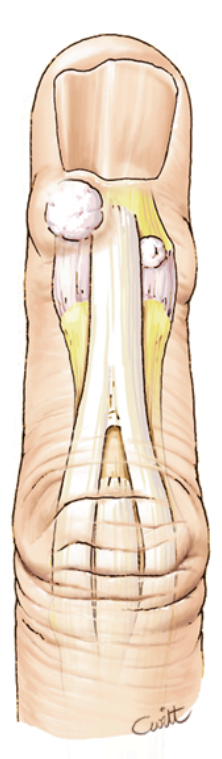
Distal interphalangeal cysts with nail deformation
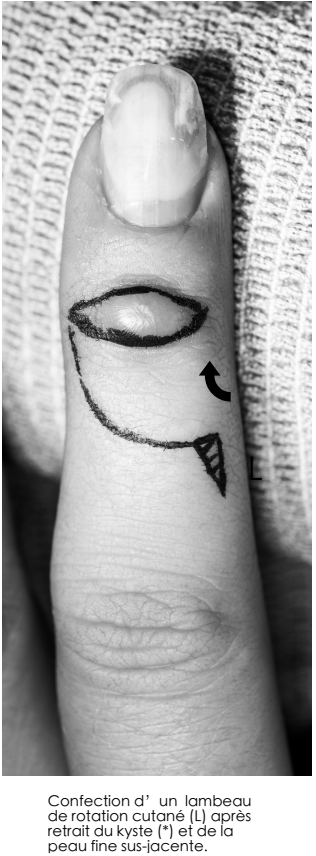
Cyst on the palmar side of fingers, from the A2 pulley. Even small they can be very bothersome
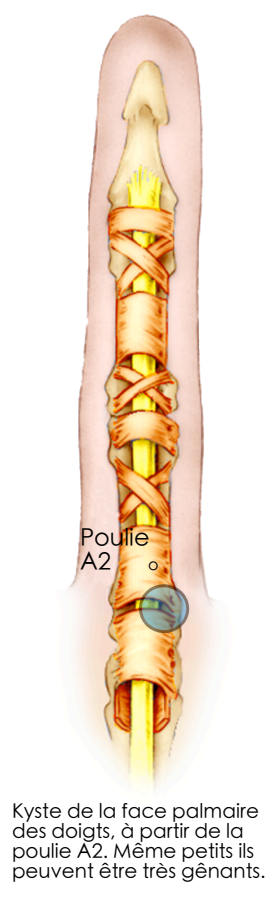
Finger cysts
Particularities of distal interphalangeal joint cysts
At the distal interphalangeal joint level (near the nail), cysts can press on the nail matrix (nail manufacturing zone) causing a groove deformation, which will progressively correct when the cyst is resected.
⚠️ Infection risk
In cases where the skin is very fragile over the cyst, intervention is preferable before the cyst opens to the outside (creating a fistula), because the risk of cyst and joint infection is then major.
I have a cyst, what can be done?
Nothing, if this cyst is not bothersome.
Surgical treatment
Otherwise, it can be operated on, with the intervention removing the cyst and the adjacent "diseased" capsule portion.
⚠️ To avoid: puncture or aspiration
However, puncture or aspiration of the cyst should be avoided as it leads to frequent recurrences, because the cyst wall produces its own synovial fluid, and there is a risk of infection if the puncture is done in non-sterile conditions.
I'm going to have cyst surgery... what will happen to me?
It is a short procedure, under regional anesthesia, most often outpatient.
Healing
Two weeks of healing are necessary, and the hand should be used immediately to preserve mobility. Of course, a skin scar remains, a sign of the surgical intervention.
Skin flap technique
When the cyst weakens the skin (often valid for distal interphalangeal joint cysts), it thins and must be removed to allow good quality healing and limit recurrences. This causes a substance loss that is sutured by flap by "sliding" the skin from the dorsal side of the finger, like a "facelift".
⚠️ Important early mobilization
The finger must be moved completely in the days following the operation, to reduce adhesions and the risk of stiffness.
Is cyst surgery risk-free?
No, of course not. Although it is a codified, routine and mastered procedure, the risk exists, as with any surgery, even if complications are very rare.
We mainly find, even if all precautions are taken:
- Healing difficulties
- Hematoma
- Local infection
- Anesthetic complications
- Slight decrease in joint mobility sometimes observed from joint capsule healing
There is especially the risk of cyst recurrence (10-15%), which is not strictly speaking a complication, but rather belongs to the evolution of the capsular disease.
A new surgery can be proposed in the same way if it is bothersome again. Finally, joint pain can linger, as a consequence of underlying osteoarthritis.
What is the risk of not having surgery?
The cyst can increase in volume or regress on its own. The only risk is that of increasing discomfort.
Distal interphalangeal joint cysts (mucoid cysts) expose to the risk of joint infection if they rupture, and are readily removed as soon as the skin covering them becomes too thin.